
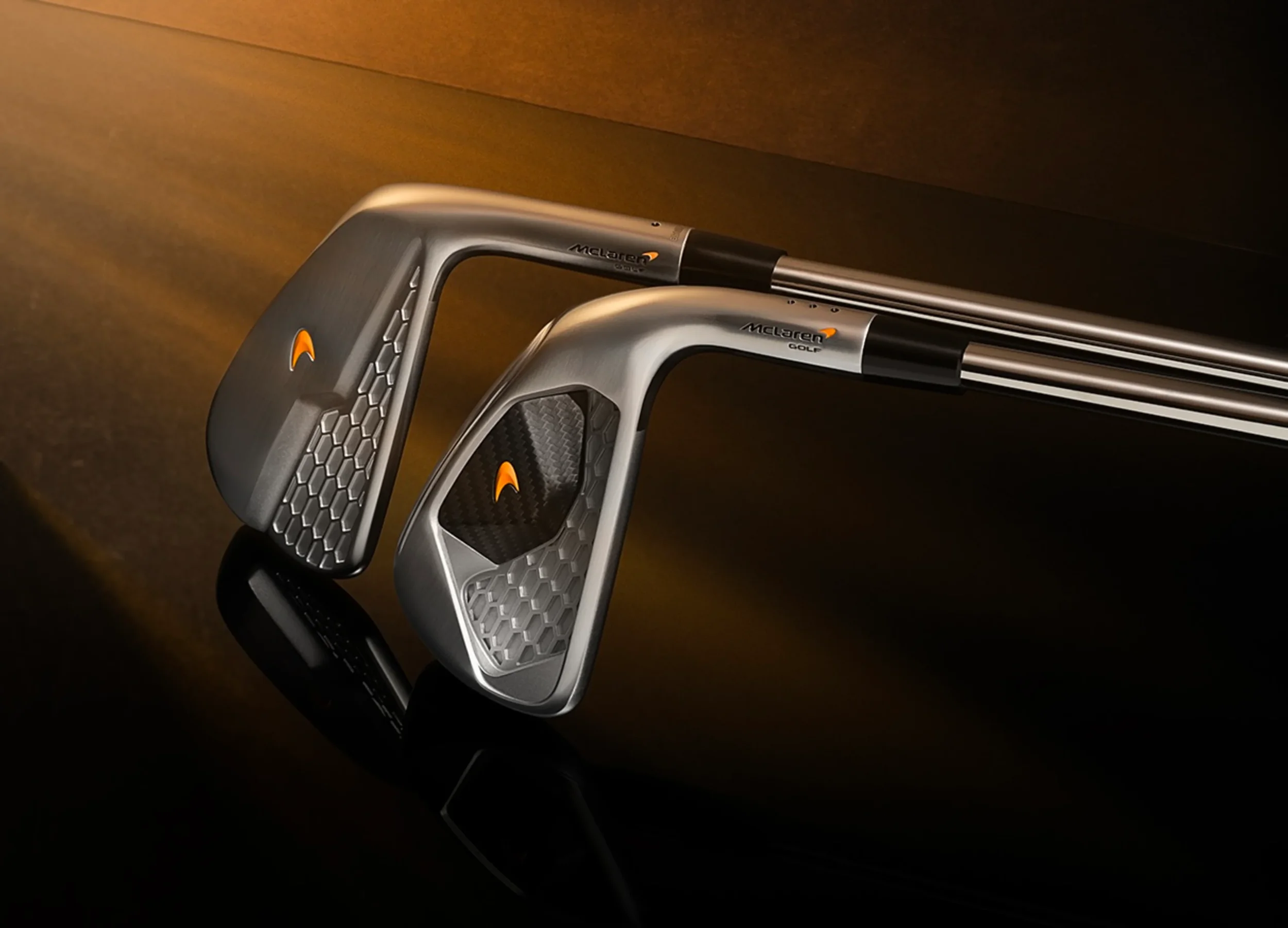
There is a moment, sometime around the third glass of something chilled at the 19th, when a golfer might reasonably ask themselves: what this game really needs is the people who make the Woking supercar. McLaren, it turns out, had the same thought — and unlike most 19th hole epiphanies, they actually acted on it.
McLaren Golf arrived yesterday, as these things do, with considerable fanfare and very little apology. Two irons. One Tour blade developed with Justin Rose. A price point of £290 per club that suggests they are not, in fact, coming for your Sunday Stableford. And somewhere in the background, the faint sound of Lando Norris nodding approvingly.
The timing, of course, is not accidental. Golf and Formula 1 have been conducting a very public courtship for several years now, the kind that involves matching outfits at pro-ams and Instagram stories from hospitality suites. Lando Norris has become as recognisable in golf circles as some tour professionals. Rory McIlroy turns up at Grands Prix with the ease of a man who has two passports and knows how to use them. The paddock, it seems, discovered the fairway — and the fairway, rather flatteringly, let them in.
McLaren has simply looked at all of this and done what McLaren does. It has engineered a conclusion.
The Series 1 iron — a Tour blade, no less, developed alongside Justin Rose and priced accordingly — arrives with all the hallmarks of a brand that does not do things by halves. Tungsten back-weight. Proprietary metal blends. Something called Structural Mesh borrowed directly from McLaren's supercar architecture, which is exactly the sort of detail that sounds either thrilling or completely unnecessary depending on your handicap and your disposition.
Rose himself is an interesting choice of collaborator. Not flashy. Not young. Deeply, reassuringly competent. An Englishman who wins Majors without making a particular fuss about it. If McLaren wanted to signal that this is serious — that this is not a vanity project with a papaya logo slapped on the hosel — then Rose is precisely the right man to be standing next to at the launch.
Whether the clubs are any good, we shall leave to those with launch monitors and more patience than us. That is not really the point. The point is that McLaren has arrived on the first tee, looked down the fairway, and decided it owns the view.
The question — and it is a genuinely interesting one — is what happens next.
Golf has always had a complicated relationship with aspiration. It invented the dress code and then spent forty years arguing about whether denim was really so terrible. It built clubhouses that looked like minor stately homes and then wondered why people found it intimidating. It is a game that has, for most of its history, wanted very much to be taken seriously — and has occasionally made rather a mess of communicating that to anyone who wasn't already initiated.
What is happening now feels like a correction. The luxury brands arriving at golf's door are not coming cap in hand. They are coming with engineering teams, tour partnerships, and a seriousness of intent that the game, frankly, deserves. They are not asking to be accepted. They are simply raising the standard.
McLaren Golf is the most architecturally coherent version of this yet. A dedicated company. Proper engineering. A CEO who speaks about pushing boundaries with what sounds like genuine conviction. And Justin Rose — dependable, precise, quietly brilliant — standing at the centre of it all like a man who knew this was coming and prepared accordingly.
This is what golf looks like when it stops apologising for having taste. When it leans into the fact that yes, it is a game of precision and obsession and beauty, and that perhaps it always deserved equipment built by people who feel exactly the same way about everything they make.
McLaren Golf: thrilling, considered, and right on time.
Welcome to the course.